


DIY Audiobook Editing: Why Editing Your Own Audiobook Takes Forever

Updated: May 28

Recording your own audiobook seems simple at first: buy a microphone, set up a recording space, and start narrating. But most first-time narrators quickly discover that audiobook editing is often more difficult and time-consuming than the recording itself. Professional audiobook production requires far more than removing mistakes — it involves noise reduction, pacing correction, mastering, sound consistency, and meeting technical standards for platforms like ACX and Findaway Voices. As a professional audiobook editor with over 15 years of experience, I’ve helped authors solve the exact problems that cause DIY audiobooks to sound amateur despite hours of editing.
Editing Is the Real Time Sink
A finished audiobook sounds smooth and effortless, but behind the scenes there are hundreds - sometimes thousands - of tiny corrections being made.
Audiobook editing often includes:
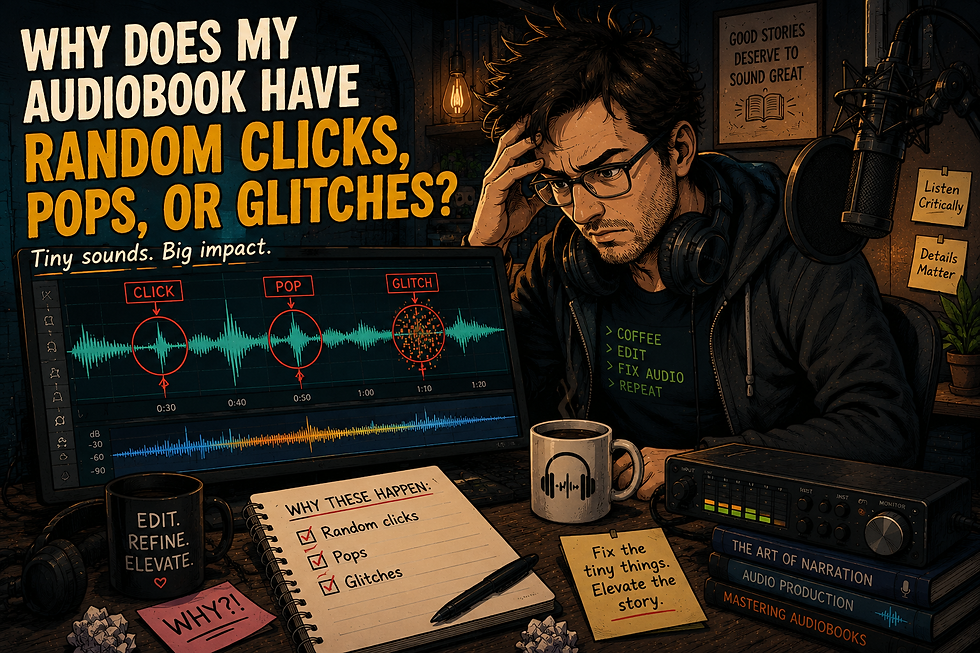
• Removing mouth noise and clicks
• Cleaning up breaths
• Fixing repeated lines
• Correcting pacing
• Matching volume levels
• Repairing background noise
• Eliminating long pauses
• Enhancing the overall sound
• Mastering to ACX or Findaway standards
Even experienced professionals can spend several hours editing a single finished hour of audio. For first-time narrators, it can take much longer.
Why Editing Your Own Voice Is So Difficult?
You Stop Hearing Problems Clearly
One of the biggest challenges with self-editing is that your ears get tired.
After listening to your own voice for hours, your brain starts tuning out problems. You may stop noticing:
• Room echo
• Background hum
• Mouth noise
• Harsh EQ
• Inconsistent tone
• Awkward edits
A professional editor approaches the audiobook objectively while bringing it up to industry standards.
Narration and Editing Are Completely Different Skills
Narrating a book and engineering audio require different mindsets.
A narrator focuses on:
• Performance
• Emotion
• Pacing
• Character consistency
• Clarity
An editor focuses on:
• Technical quality
• Cleanup
• Noise reduction
• Timing
• Audio consistency
Trying to master both at once can quickly become exhausting.
The Endless Editing Spiral
This happens more often than people realize:
You edit a chapter.
Then you listen again and notice more issues.
So you apply noise reduction.
Now the audio sounds metallic.
You add EQ.
Now the voice sounds harsh.
You add compression.
Now the breaths are too loud.
Hours later, the audiobook somehow sounds worse than when you started.
Professional audiobook editing is not just about using plugins. It’s about understanding what should be fixed — and what should be left alone. Over-processing is one of the most common mistakes in DIY audiobook production.
Why Professional Audiobooks Sound Different
Professional audiobooks usually involve:
• Proper recording technique
• Treated recording environments
• Experienced editing
• Quality control review
• Mastering to platform specifications
The listener never notices the editing because good editing disappears into the storytelling.
That invisible polish is what many authors struggle to recreate on their own.
When DIY Makes Sense — And When It Doesn’t
Some authors genuinely enjoy learning audio production, and for certain projects DIY narration can absolutely work.
But if:
• editing is draining your energy,
• the project has stalled,
• you’re spending weeks fixing technical issues,
• or you’re constantly second-guessing the sound quality…
…it may be time to bring in professional help.
Sometimes the fastest way to finish an audiobook is to stop trying to do every part of it yourself.
Final Thoughts
Most authors underestimate audiobook editing because the work is invisible when it’s done well.
Professional audiobook editing involves organization, efficient workflows, critical listening skills, and a toolbox of specialized plugins designed to solve very specific problems.
Editing is often the difference between an audiobook that sounds polished and one that sounds amateur.
A strong narration deserves strong production. And sometimes the best decision an author can make is to focus on the storytelling — while letting a professional handle the technical side. For many authors, working with a professional editor ultimately saves time, reduces frustration, and allows them to focus on the performance itself.

Comments