


Behind the Mic: What A Harry Potter Audiobook Sounds Like in the U.S. and the U.K.

Updated: Jul 23
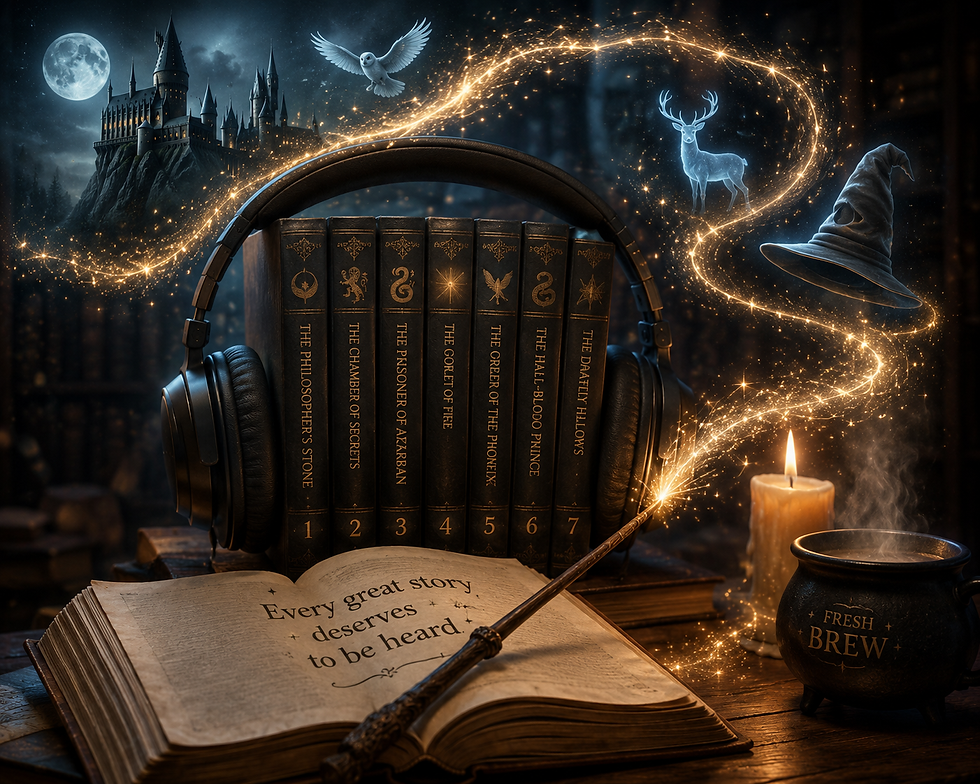
“For an entire generation of listeners, Hogwarts didn’t first come alive on screen. It came alive through a pair of headphones.”
When people talk about a Harry Potter audiobook, they usually celebrate J.K. Rowling’s books or the blockbuster films. But for millions of fans, the Wizarding World has another set of stars: the voices that guided them through every Quidditch match, every spell, and every battle against Voldemort.
More than twenty-five years after the first audiobook was released, the Harry Potter series remains one of the most successful audiobook productions ever created. The recordings have introduced countless listeners to the magic of audiobooks and set a standard that many narrators still aspire to today.
At the heart of that success are two remarkable performers: Stephen Fry, who narrated the books for the United Kingdom and much of the world, and Jim Dale, whose performances became beloved throughout the United States.
They read the same words.
Yet they created two unforgettable and very different journeys to Hogwarts.
Harry Potter Audiobook Timeline
· 1997 – Harry Potter and the Philosopher’s Stone is published.
· 1999 – The first Harry Potter audiobooks are released.
· Stephen Fry records the British editions.
· Jim Dale records the American editions.
· Over the next decade, both narrators complete all seven novels.
· 2024 – Audible announces an ambitious new full-cast adaptation featuring more than 100 performers, original music, immersive sound design, and Dolby Atmos technology.
The new productions are spectacular in their own right, but they exist because the original recordings became classics.
Stephen Fry:
Listening to Stephen Fry, it’s easy to forget you’re hearing a performance.
That’s exactly the point.
In interviews reflecting on the series, Fry rarely talks about “acting.” Instead, he speaks about serving the story. His narration is calm, conversational, and remarkably restrained. Rather than giving every character an exaggerated voice, he uses subtle changes in rhythm, tone, and timing to distinguish them.
The result is storytelling that feels effortless—even though it isn’t.
One of Fry’s most famous recording stories has become Harry Potter folklore.
While recording one of the early books, he repeatedly stumbled over the phrase “Harry pocketed it.” After mentioning his frustration to J.K. Rowling, she reportedly found it hilarious and continued using variations of the phrase in later books. Fry now tells the story with characteristic humor, reminding us that even the most accomplished narrators have their nemeses hidden inside seemingly simple sentences.
He has also spoken about another challenge that audiobook listeners rarely consider: consistency.
The Harry Potter novels were recorded over many years. Characters disappeared for entire books before returning later in the series. Fry had to remember not only their voices, but their personalities, emotional rhythms, and relationships—sometimes years after first recording them.
Jim Dale: Becoming an Entire Cast
If Stephen Fry is the storyteller, Jim Dale is the company of actors.
Harry Potter contains an enormous cast of witches, wizards, ghosts, giants, goblins, professors, house-elves, and magical creatures. Dale has explained that every important character needed a recognizable identity while remaining believable over hundreds of pages.
His performances eventually included well over one hundred distinct voices, earning him recognition from Guinness World Records.
But creating the voices was only half the challenge.
Remembering them was the real test.
Recording sessions were spread across weeks and months. Dale had to return to characters sounding exactly as listeners remembered them, maintaining vocal consistency over thousands of pages of narration.
It’s a feat of concentration as much as performance.
The Great Debate
Ask Harry Potter fans which narrator is better and you’re likely to start a lively discussion.
Supporters of Stephen Fry praise his warmth, wit, and understated elegance. They say listening to him feels like sitting beside a favorite uncle telling a story on a rainy evening.
Fans of Jim Dale admire his extraordinary range of character voices and dramatic energy. They argue that he transforms each chapter into a one-man theatrical performance.
The remarkable thing is that neither side is wrong.
The continuing debate is perhaps the greatest compliment either narrator could receive. More than two decades later, listeners are still passionately recommending “their” version to new fans discovering the series for the first time.
Life Inside the Recording Booth
Neither narrator has spent much time discussing microphones or editing software.
Instead, both describe audiobook recording as an intensely solitary craft.
There are no costumes.
No elaborate sets.
No visual effects.
No fellow actors standing across the room.
Everything depends on the voice.
A pause before a revelation.
A whisper during a secret conversation.
The confidence of a headmaster.
The nervousness of a first-year student.
For hours at a time, one person must create an entire world using nothing but breath, timing, and imagination.
A New Chapter
In 2024, Harry Potter returned to the recording studio in spectacular fashion.
Audible announced a new full-cast production featuring more than one hundred performers, immersive Dolby Atmos sound, original music, and richly layered sound design.
Behind-the-scenes videos reveal actors holding replica wands while recording duels and even eating real food during Great Hall scenes to make conversations sound authentic.
It’s a very different style of production from the original audiobooks, but it follows the same guiding principle: if the performers believe the world they’re creating, listeners will believe it too.
The Lasting Magic
Technology has transformed audiobook production since Harry Potter first arrived on cassette.
Studios are quieter.
Software is more powerful.
Editing is faster.
Distribution is instant.
Yet listeners continue to return to the original recordings year after year.
That isn’t because of technology, it’s because of storytelling.
Stephen Fry and Jim Dale approached the same books from different directions, yet each accomplished the narrator’s highest goal: to disappear behind the words until listeners forget they’re hearing a single performer.
The Harry Potter audiobooks remind us that while every great audiobook begins with a great author, it reaches listeners through the combined artistry of narrators, directors, editors, recording engineers, and producers whose work is largely invisible—but whose craftsmanship can turn a beloved novel into an unforgettable listening experience.
Planning an audiobook? Whether you're just getting started or preparing for publication, we're happy to discuss your project and guide you through every step—from recording to final upload.


Comments